On this page
Two keyboards with the same switches, keycaps, and PCB can feel and sound wildly different depending on how the plate and PCB are mounted inside the case. Mounting style is the second-biggest decision (after switches) for anyone who cares about how a keyboard feels under their fingers. Here's a plain-English tour of the options.
What "mount" actually refers to
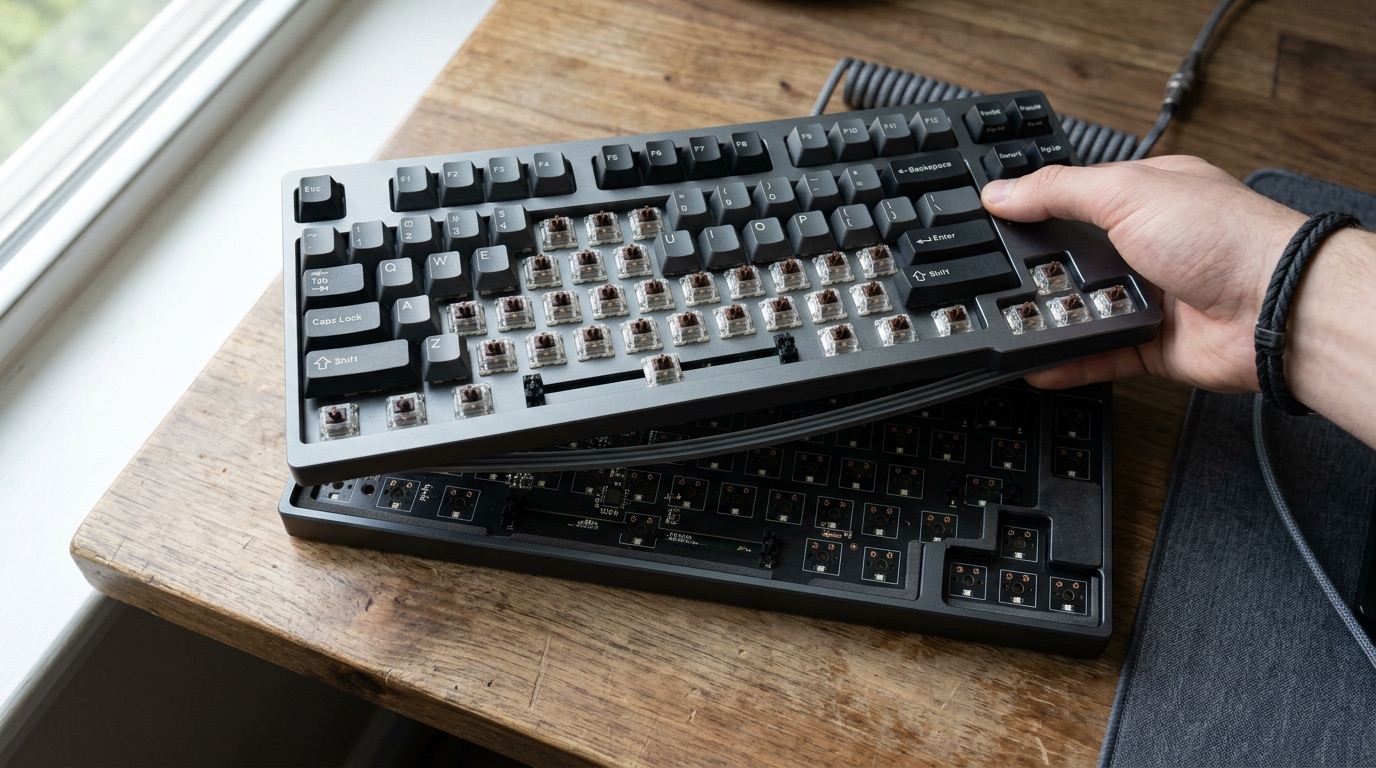
Inside a keyboard case, two things need to be secured: the plate (the sheet the switches clip into) and the PCB (the circuit board the switches are soldered or socketed to). The "mounting style" describes how those are held in place and how much they flex when you type.
More flex = softer, more cushioned, often more acoustically rich. Less flex = stiffer, more direct, often louder and more "pingy" if not dampened.
At a glance — all 8 styles
| Mount | Flex | Where it shines | Where you'll see it |
|---|---|---|---|
| Tray | Uneven | Cheap & moddable | Keychron K-series, GMMK, budget customs |
| Top | Very low | Classic clack | NK65, Filco, older enthusiast boards |
| Bottom | Low | Stiff but pingless | Some classic customs (Mode Sonnet, older Tofu) |
| Gasket | Medium | The modern default | Keychron Q & V, GMMK Pro, Leobog Hi75 |
| O-ring | Medium-low | Damped, simple | Mostly retired |
| Leaf-spring | High | Bouncy enthusiast custom | High-end customs |
| Plateless | Highest | Maximum flex | PC-only builds |
| Burger | Medium-high | Subtle, no ping | Boutique builds |
Tray mount
The oldest and cheapest: PCB screws directly to posts on the bottom of the case. The plate just sits on top, held down by the switches clipping through it into the PCB.
- Feel: Stiff, uneven (bottom middle flexes more than edges).
- Sound: Neutral-to-hollow, depending on case material and foam.
- Build complexity: Minimal.
- Cost: Cheapest.
Found on entry-level Keychron K-series (pre-Pro), GMMK (non-Pro), Drop CTRL, and most budget customs.
Top mount
The plate screws directly to the top shell of the case. The PCB just rides along underneath, held in place by the switches.
- Feel: Stiff, uniform. Very direct — you feel the case.
- Sound: Typically sharper, higher-pitched, more "clack." Can be modded toward thock with foam/tape mods.
- Build complexity: Simple.
- Cost: Medium.
Traditional enthusiast standard for years. Less common on new boards now that gasket has taken over, but still found on classic customs like the NovelKeys NK65 (Aluminum / Entry editions).
Bottom mount
The plate-and-PCB sandwich screws to the bottom of the case rather than the top shell. Mechanically a mirror of top mount, but acoustically distinct — because the top shell doesn't press on the plate, you avoid the ringing sometimes heard on top-mount boards.
- Feel: Stiff, uniform — similar to top mount.
- Sound: Less prone to ping than top mount; can sound a touch deeper.
- Build complexity: Simple.
- Cost: Medium.
Found on some classic customs and a handful of older Tofu60/65 variants. Less common than tray, top, or gasket today.
Gasket mount
The plate is sandwiched between soft silicone or Poron "gaskets" mounted to the top and/or bottom of the case. The plate doesn't touch the case directly — gaskets isolate it, giving some vertical flex when you press a key.
- Feel: Softer, more cushioned. The amount of flex depends on gasket thickness, hardness, and how many contact points there are.
- Sound: Warmer, deeper, more damped. Less ping.
- Build complexity: Medium.
- Cost: Medium to high. Dominant style on mid-and-up enthusiast boards.
O-ring mount
An O-ring sits between the plate and the case (often between plate and bottom of the top shell). Similar idea to gasket mount but with a single rubber ring rather than discrete gasket strips.
- Feel: Softer than top mount, less engineered than gasket. Can feel "floaty" depending on ring density.
- Sound: Well-damped, often bassy.
- Build complexity: Simple.
- Cost: Low to medium.
Mostly a pre-gasket transitional style. Rare on modern releases — most boards that used to ship O-ring mount have since moved to proper gasket setups.
Leaf spring / flex-cut
The plate is suspended in the case by extension tabs that flex by design, or the plate has flex cuts (vertical slots) milled into its body to soften the travel. Variants include "leaf-spring mount" proper (Mode Envoy-style) and flex-cut FR4 plates dropped into a gasket cradle.
- Feel: Most flex of any mainstream style. Bouncy, almost spongy.
- Sound: Highly dependent on plate material; FR4 with flex cuts tends to be warm and deep.
- Build complexity: Medium.
- Cost: High-end custom territory mostly.
Plateless / PCB-direct
No plate at all — the switches clip directly into the PCB itself, and the PCB takes the load. Usually paired with a polycarbonate or POM PCB and a soft case. The most extreme flex of any style.
- Feel: Bouncy and a bit loose. Polarising — many people love it for long-form typing, others find it too unstable for gaming.
- Sound: Deep, "thocky", often uniquely bassy.
- Build complexity: Higher than plate-mounted (switches need to be straight going in, no plate to align them).
- Cost: High-end / boutique.
Less common but worth knowing
- Burger mount — gaskets on all four plate edges, fully isolating it.
- PCB mount — plate attaches to the PCB, PCB attaches to case; transfers any case stiffness to the plate too.
- Integrated plate — plate is part of the case itself, machined in. Very stiff, often expensive, mostly boutique builds.
Feel/sound summary
| Mount | Flex | Sound character | Build cost | Dampening needed |
|---|---|---|---|---|
| Tray | Uneven | Neutral to hollow | Low | Moderate (foam, tape) |
| Top | Very low | Sharp, clacky | Medium | Medium (foam) |
| Bottom | Low | Stiff but less ping than top | Medium | Medium |
| Gasket | Medium | Warm, thocky | Medium-high | Low (built-in) |
| O-ring | Medium-low | Damped, bassy | Low-medium | Low |
| Leaf spring | High | Bouncy, plate-dependent | Medium | Low |
| Plateless | Highest | Deep, thocky, soft | High | Low |
| Burger | Medium-high | Very damped | Medium-high | Low |
Picking by priority
- First enthusiast board, you want "the good feel": Gasket, aluminum case, FR4 or PC plate. Keychron Q series, Leobog Hi75, GMMK Pro are all good starting points.
- You want a sharp, classic clack: Top mount, brass or steel plate.
- You're on a tight budget: Tray mount + aftermarket foam kit. Perfectly fine result.
- You want the most flex possible: Leaf-spring or plateless build, PC plate, no foam.
- You want subtle elegance, no ping: Burger mount or well-engineered gasket with PC plate.
What mount can't do
- Fix bad stabilizers. A ticky, rattly stab ruins a great mount. See our stabilizers 101 guide.
- Fix unlubed loud switches. Mount softens bottom-out; it doesn't silence switch rattle.
- Turn ABS into aluminum — a polycarbonate case with fancy mount will still sound cheaper than an aluminum case with a basic mount.
Common pitfalls
- Chasing "gasket" as a buzzword. Badly implemented gasket mount can feel stiffer than good top mount. Read reviews.
- Ignoring plate material. Same mount with brass vs PC plate = two totally different keyboards.
- Over-foaming. Stuffing every cavity with foam kills the sound character. Start with less and add if needed.
- Buying a "soft flex" board for gaming. Too much flex can feel mushy under rapid actuation. Stiffer mounts suit gaming.
FAQ
What's the best mount for gaming? Stiffer mounts (top, bottom, well-foamed tray) feel more responsive under fast inputs. Heavily-flexed gasket or plateless can feel mushy in fast-twitch shooters. For mixed gaming + typing, a gasket with a stiff plate (aluminum or brass) is a good compromise.
Top mount vs bottom mount — what's actually different? Mechanically they're mirrors. The acoustic difference is that top mount couples the plate to the top shell (which can ring), while bottom mount couples it to the bottom panel (less surface area, less ring). Feel is similar.
Is gasket mount always better? No. A poorly-implemented gasket mount (thin or hard gaskets, too few contact points) can feel stiffer than a well-foamed tray mount. "Gasket-mounted" on the spec sheet is no guarantee — read reviews of the specific board.
Can I switch a tray-mount keyboard to gasket? Generally no — the case has tray-mount posts, not gasket cradles. You can soften it with foam, tape, and PE film mods, but you can't retrofit gasket mounting without replacing the case.
Further reading
Our 2026 picks
See all 368 keyboards in the database
Compare specs, view history, see stats and vendor prices — the tools back you up past this article.
Keep exploring