On this page
Keycap profile changes how your keyboard feels more than almost any other upgrade. Two boards with identical switches but different profiles can feel like totally different products. This guide walks through the seven profiles you'll actually see for sale, what they're good at, and where each one goes wrong.
What "profile" actually means
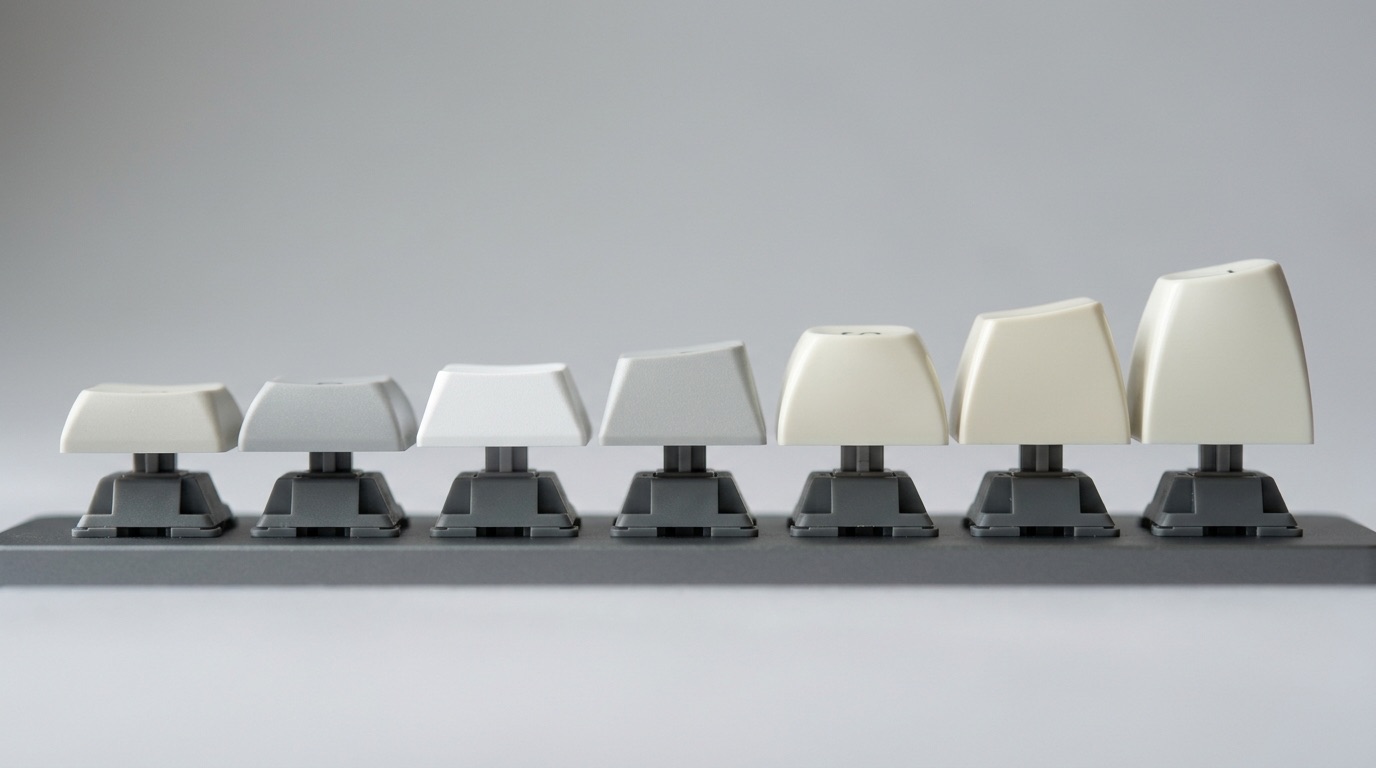
A keycap profile is the combination of three things:
- Height — how tall the cap is, typically 5–18 mm.
- Sculpt — whether each row has a different shape (R1–R4) or every row is identical (uniform).
- Top surface — flat, spherical (dished), or cylindrical (saddle-shaped).
Everything else — material, legend method, colorway — is orthogonal to profile. You can have Cherry profile in ABS or PBT, dye-sub or doubleshot. That's personal taste, not profile.
Material vs profile — don't conflate them
A keycap's material (ABS, PBT, POM) controls weight, surface texture, and sound brightness. Profile controls geometry. The two interact (a tall PBT cap sounds different from a tall ABS cap), but choosing one doesn't lock you into the other. Most profiles are available in both ABS doubleshot (GMK, EnjoyPBT) and PBT (PBTfans, KBDfans, ePBT). You can slice the catalog either way: PBT sets and ABS sets by material, doubleshot and dye-sub by how the legends were made.
Cherry
Origin: Cherry Corp (Germany), late 1980s. The original enthusiast profile.
The de facto standard for enthusiast keyboards. Short, sculpted, cylindrical top. Originally Cherry Corp's own profile, now made by dozens of vendors (GMK, PBTfans, ePBT, KBDfans, etc.). Easy to type on, familiar to anyone who has ever used a mechanical keyboard. Browse every Cherry-profile set we track.
OEM
Origin: Generic industry name for the cylindrical profile most pre-built keyboard manufacturers use as default since the 1990s.
Slightly taller than Cherry, same cylindrical sculpt pattern. This is what most prebuilt keyboards ship with. Fine, but not usually anyone's favorite once they try alternatives. The extra height gives a touch more leverage but also more travel feel, which some people love and others find fatiguing. See the OEM-profile sets in the database. It is a smaller group than you might expect: a lot of what ships on prebuilts is a house profile the vendor made itself rather than true OEM, and we file those under their own names.
SA
Origin: "Spherical All-rows", Signature Plastics (USA), 1970s. A throwback to the typewriter era — many people first saw SA on the iconic IBM Model F-style sets.
Tall and spherical-topped. Retro styling, heavy premium feel, distinctive "thocky" sound in the low-mids. SA is divisive — either you love the sculpt or you hate the height (around 16.5 mm at the top row). Steep learning curve because your fingers are much further from the base than Cherry.
MT3
Origin: Designed by Matt3o (Massimo Cerolini), manufactured by Drop, first released around 2018. Inspired by the IBM beamspring and the Selectric typewriter.
Matt3o's profile, made by Drop and licensed to a few others. Spherical dished tops like SA but with a more pronounced scoop and a different sculpt curve. The dish is noticeably deep, which feels fantastic once your fingers "find home" but can feel awkward on the number row where your hand doesn't rest.
DSA
Origin: "DIN-Spherical-All", Signature Plastics. The uniform-height sister profile to SA.
Uniform height, spherical flat tops. No row sculpt — every key is identical in height and shape. Great for ortholinear boards and minimalist builds. The flat spherical tops are a love-it-or-hate-it feel; some find them "floaty."
KAT
Origin: Keyreative (China), ~2019. Designed as a more accessible alternative to SA at a similar size.
Keyreative's profile. Think of it as "SA, but sensible." Medium-tall, sculpted, spherical tops. Sits in the pocket between Cherry's familiarity and SA's presence. Popular with designer colorway drops because the large top surface gives the legends room to breathe.
XDA
Origin: A uniform flat profile popularized around 2018. Often produced as generic PBT sets without a single trademark owner.
Uniform height like DSA but slightly larger top surface and less pronounced dish. Clean, flat, modern-looking. Great for minimalist builds and anyone whose typing style has them hitting keys dead-center rather than glancing off the side.
Why MT3 and KAT matter
Most online "Cherry vs OEM vs SA vs DSA vs XDA" comparisons skip MT3 and KAT entirely — usually because the writers haven't tried them, and the profiles are produced in smaller volumes by fewer vendors. Both deserve their own slot:
- MT3 is the only mainstream profile with a genuinely deep spherical scoop. Once your fingers learn the home row, MT3 actively pulls them back to centre. People who've tried it rarely go back to flat profiles for long-form typing.
- KAT is the practical answer to "I love SA's look but hate typing on it." Sculpt without the punishing height, and most KAT runs ship excellent PBT with sharp legends.
If you read other guides and they only cover 5 profiles, those guides don't include the two most interesting modern options.
Side-by-side
| Profile | Height | Sculpt | Top shape | Typing feel | Sound signature |
|---|---|---|---|---|---|
| Cherry | Short (9.4 mm) | R1–R4 sculpted | Cylindrical | Familiar, low effort | Neutral / balanced |
| OEM | Medium (11.9 mm) | R1–R4 sculpted | Cylindrical | Like Cherry, taller | Slightly louder |
| SA | Tall (16.5 mm) | R1–R4 sculpted | Spherical | Retro, heavy, learning curve | Thocky, low-mid |
| MT3 | Tall (~12–16 mm) | R1–R4 sculpted | Deep spherical | Scooped, home-finding | Thocky, full |
| DSA | Short (7.6 mm) | Uniform | Flat spherical | Minimal, flat | Clackier, higher |
| KAT | Medium-tall (~11 mm) | R1–R4 sculpted | Spherical | SA-lite | Between Cherry and SA |
| XDA | Short-medium (9.2 mm) | Uniform | Flat spherical | Clean, modern | Clackier |
Sound differences
Profile affects sound through three mechanisms: internal volume of the keycap, stem length, and how the cap interacts with the keyboard's plate and case. Taller caps with more internal volume (SA, MT3) produce more low-mid "thock." Shorter profiles (Cherry, DSA) emphasize the click of the switch stem and sound higher-pitched.
This is also why the same switch can sound completely different across profiles — the cap is a resonant chamber sitting on top of the spring.
Picking by scenario
- First enthusiast build. Cherry, ABS or PBT, whatever colorway you like.
- Retro aesthetic or designer keyset. SA or MT3 — their tall sculpts make colorways pop.
- Ortholinear / 40% board. DSA, KAT, or XDA. Uniform profiles solve the problem of sculpted rows not aligning on unusual layouts.
- You hate typos from glancing hits. MT3's deep dish really does guide your fingers. KAT is a gentler version of the same idea.
- You want quiet clack. Cherry PBT. Not sexy advice, but it's the right answer.
Common pitfalls
- Buying SA without trying it. The height is polarizing. Borrow before you buy.
- Mixing profiles across your board. Unless you know you like it, it looks and feels wrong.
- Assuming PBT = better. PBT is more durable and usually quieter, but top-tier ABS doubleshots (GMK, EnjoyPBT) have sharper colors and a very specific sound many enthusiasts prefer.
Related reading
- Switches 101 — pick the switch family first, then the cap.
- Mounting styles explained — the other big variable in how a board feels and sounds.
Our 2026 picks
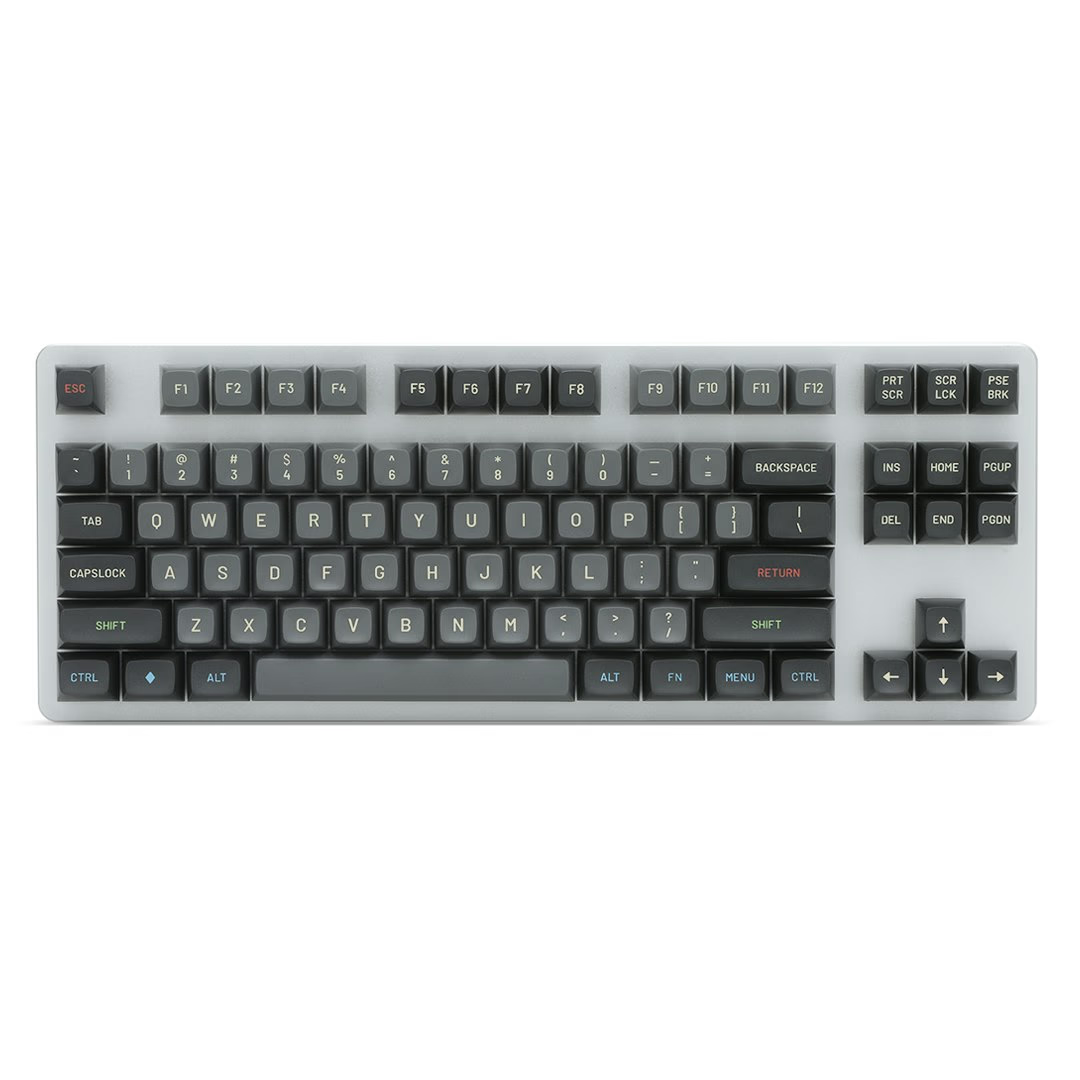
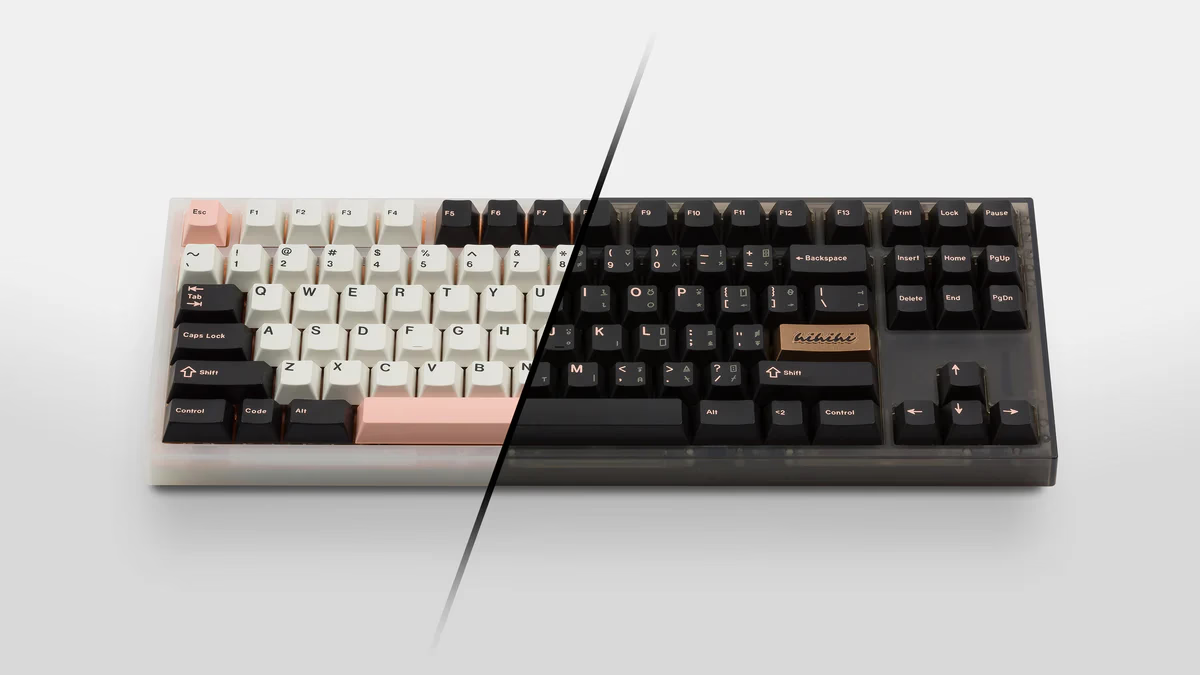
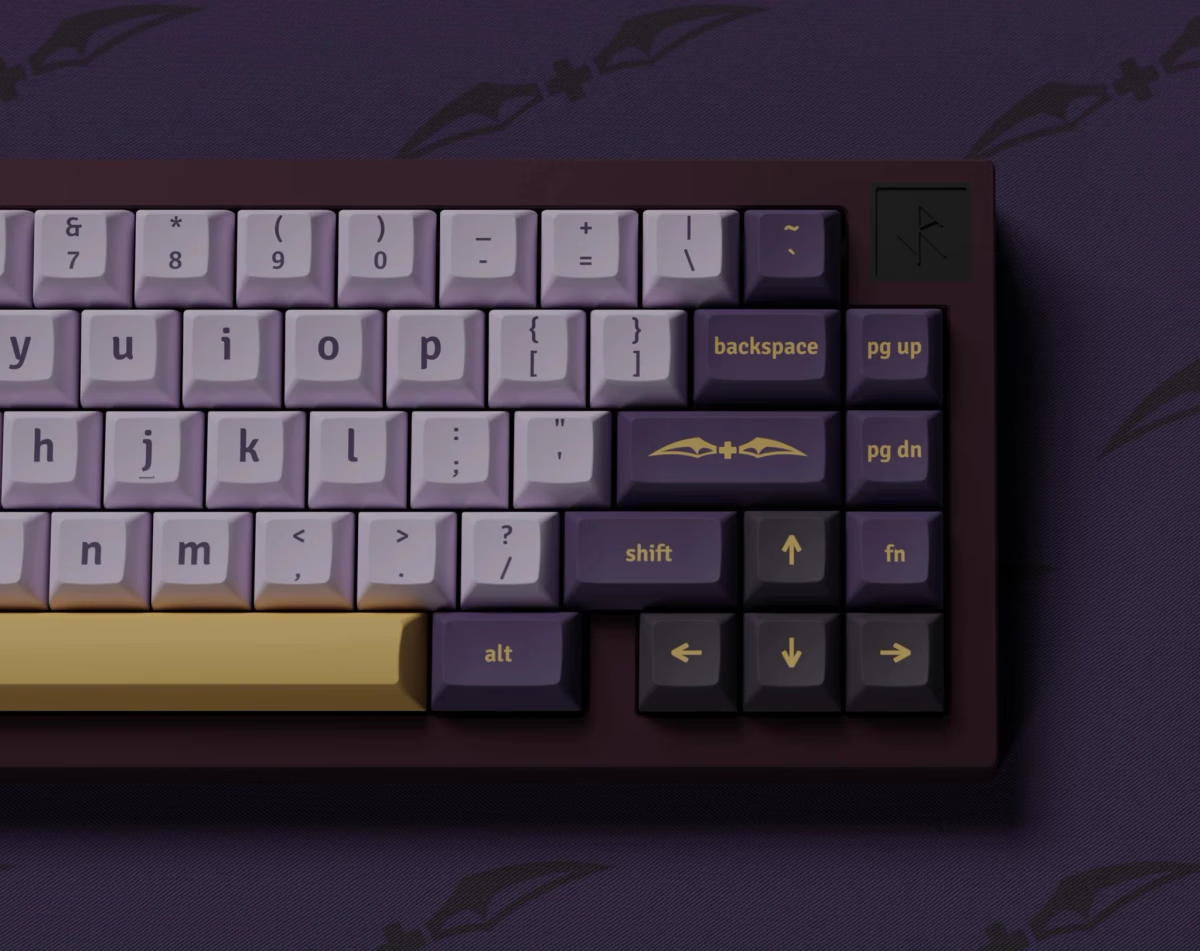
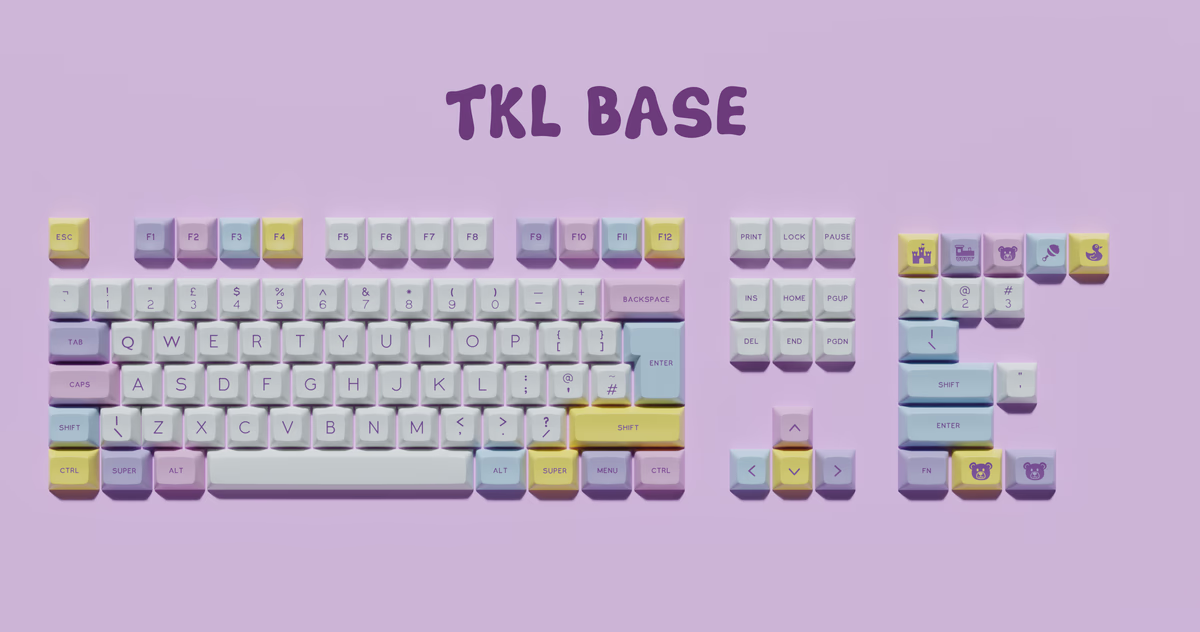
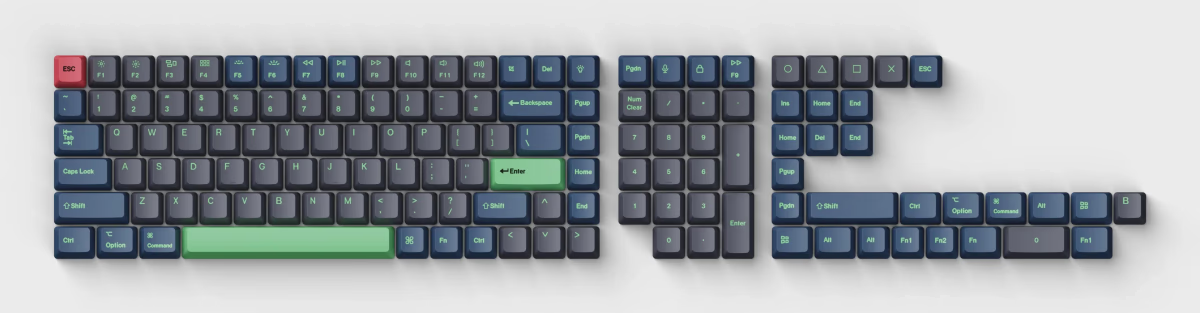
See all 71 keycap sets in the database
Compare specs, view history, see stats and vendor prices — the tools back you up past this article.
Keep exploring