Stabilizers
The most complete structured stabilizer database on the web — something no competitor currently tracks at field level. Filter by mount (screw-in, snap-in, plate), size, housing material, and factory-lube status.
1 stabilizerShowing 1-1
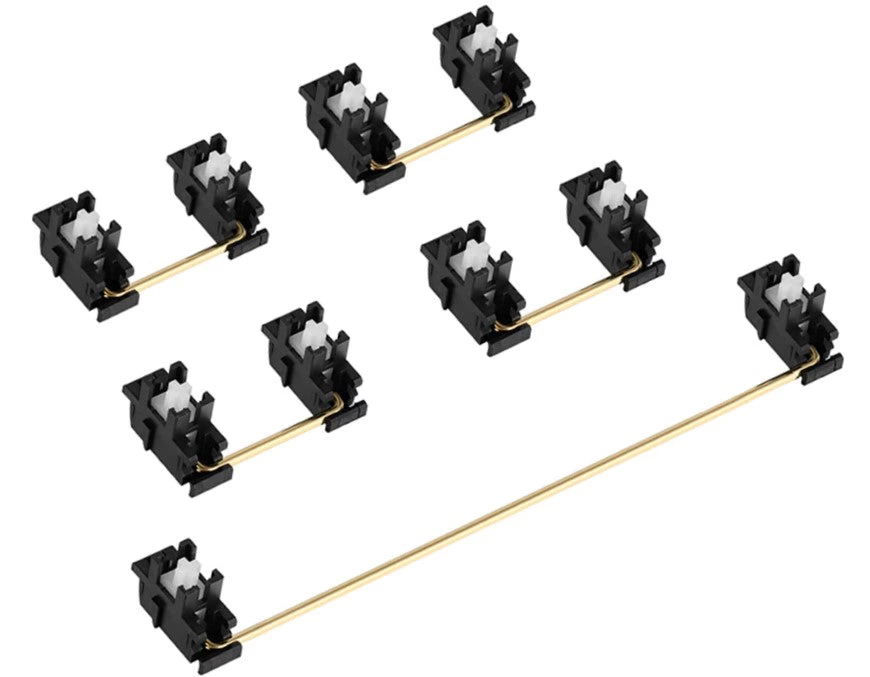
About keyboard stabilizers
Stabilizers (stabs) sit under your longer keys — spacebar, shift, enter, backspace, numpad plus — so they press evenly along their length instead of tilting and binding. A bad stab is the single biggest source of rattle and mushy feel on an otherwise great keyboard, which is why a lubed, well-chosen set is the highest-impact upgrade most builders can make.
There are four mounting types. Screw-in PCB-mount stabs fasten to the PCB with small screws through the housing — no wobble, no popping out mid-mod, and the enthusiast default. Clip-in (snap-in) PCB-mount stabs use plastic tabs instead of screws: quicker to install but they can pop loose during keycap swaps. Plate-mount stabs clip into the switch plate and are mostly seen on budget or vintage boards. Snap-in is a looser sub-type of clip-in with the same trade-offs.
Housing and wire material set the sound and feel. POM housings (Cherry, TX, C³Equalz) are self-lubricating and quiet; nylon housings (Durock, Wuque) are slightly grippier and a touch more affordable; polycarbonate shows up on premium sets like Staebies. Wires are usually plated steel — gold-plated wires resist corrosion and can ring less. We track all of this at the field level, plus PCB-thickness fit (most screw-in sets ship 1.2mm and 1.6mm hardware) — data no other catalogue records this granularly.
For a first build, a screw-in PCB-mount set in POM or nylon, hand-lubed with a thick dielectric grease on the wire ends, gets you 90% of the way to a rattle-free board. Factory-lubed sets are a convenient shortcut but rarely beat a careful hand-lube plus a holee-mod on the stem legs.
Frequently asked
Screw-in vs plate-mount vs clip-in — which should I get?
What size stabilizers do I need?
Does PCB thickness (1.2mm vs 1.6mm) matter for stabilizers?
POM vs nylon vs polycarbonate housing — what changes?
Are premium stabilizers (TX, C³Equalz, Staebies) worth it over Durock or Gateron?
Do I really need to replace and lube the stock stabs?
Why do stabilizer wires need lubing, and with what?
What's the holee mod and do I still need it?
Explore other stabilizer types
Common facets and sub-categories within the database.
Mount
Screw-in
Enthusiast standard — screws to the PCB for zero wobble and even pressure.
Mount
Clip-in
Clip into the PCB — easier to install, slightly less rigid than screw-in.
Mount
Plate-mount
Clip into the switch plate. Common on budget boards, easy swaps but more wobble.
Feature
Pre-lubed
Arrive silent out of the box — a decent baseline if you skip hand-lubing.